

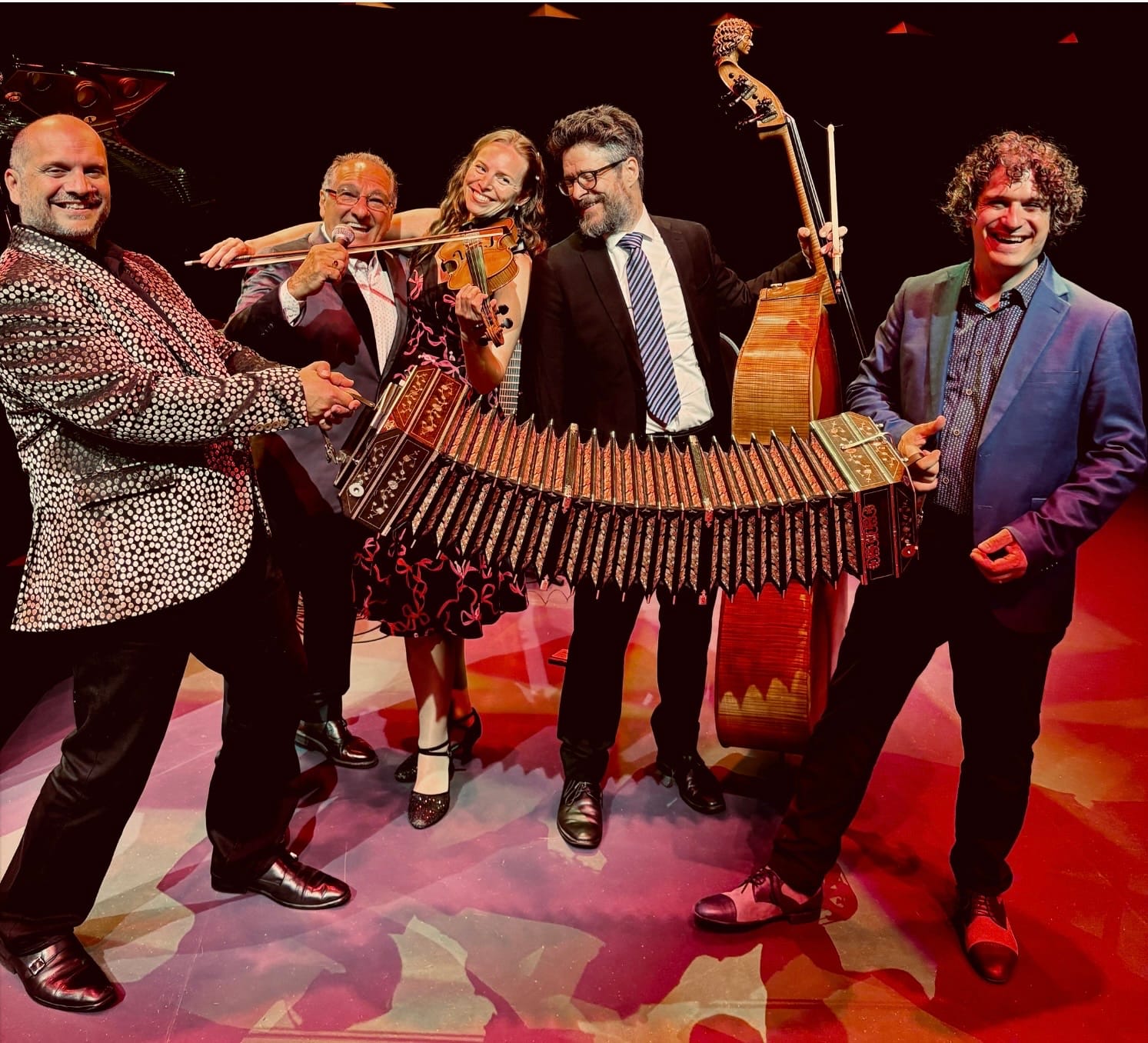
Toronto’s award-winning, superstar Payadora Tango Ensemble heats things up with ‘Tangomania’. Its five “powerhouse” musicians perform with joy, virtuosity, humour, soulfulness, and passion, combining tango with elements of classical, jazz, and world music. The instrumentalists of this technically, emotionally brilliant ensemble are classically trained, and everyone, including their fiery Uruguayan vocalist, ‘The Little Giant of the Tango’, presents their repertoire with great intensity. Instruments include bandoneon, violin, mandolin, piano, and bass. They will certainly put on a tremendously exciting concert!
Rebekah Wolkstein, founder, leader, composer, violinist, vocalist,writes:
“Payadora Tango Ensemble was founded in Toronto in 2013. Thirteen years, five albums, and performances across Canada, the United States, South America, and Europe later, we are delighted to be bringing that music to Thunder Bay on September 26, presented by Consortium Aurora Borealis.
The ensemble is led by violinist and composer Rebekah Wolkstein, who also leads the klezmer-jazz quintet Schmaltz & Pepper and serves as first violinist of the Venuti String Quartet. Drew Jurecka, a Grammy-winning producer and arranger, moves between bandoneon, violin, and mandolin, and has produced and arranged much of Payadora’s recorded output.
Joseph Phillips, principal bass of Orchestra London Canada, anchors the group on double bass. Mark Camilleri, a pianist with a 35-year career spanning concert halls, film scoring, and Broadway and Mirvish productions, rounds out the instrumental side. And Elbio Fernandez, born in Uruguay and performing since 1989, is our vocalist — nicknamed “the little giant of the tango” for the intensity he brings to the stage.
The program we’re bringing, Tangomania, traces the remarkable story of how a dance born in the port neighbourhoods of Buenos Aires and Montevideo became, by 1913, a global phenomenon that swept through Paris, London, Berlin, and New York. The evening moves from tango’s raw early roots through the golden-age orchestras of Pugliese, Di Sarli, and Troilo, into Astor Piazzolla’s fusion of tango with jazz and classical music, and finally to original compositions by Rebekah Wolkstein and Drew Jurecka that continue to push the tradition forward.
Roots Music Canada has called us “the Kronos Quartet of Tango,” and Strings Magazine wrote that our performances let “romance and whimsy dance cheek to cheek.” For this concert, it will be the quintet alone — no dancers this time — putting the music itself at the centre of the evening.
We have had the privilege of performing this repertoire at venues ranging from the National Arts Centre in Ottawa to the Rudolstadt Festival in Germany, with a sold-out European tour in 2023 that included a live broadcast on the BBC. Along the way, our recording *Silent Tears: The Last Yiddish Tango* reached #1 on the World Music Charts Europe and earned Germany’s Weltmusikpreis RUTH, among other honours.
Alongside the larger venues, we’ve also come to value the smaller halls and community concert series across the country, where the connection with the audience is often most immediate. We’ve heard Thunder Bay is known for exactly that kind of warmth, and we’re looking forward to experiencing it firsthand.
For anyone who hasn’t encountered tango performed this way — not as accompaniment for dancing, but as concert music drawing on classical, jazz, and folk traditions in equal measure — this concert offers a good introduction. We’d encourage newcomers to the genre, and to our concert series, to come out and hear it.”
She goes on to write in greater detail, as follows:
“I fell in love with tango as a student at Cleveland’s Institute of Music, listening to Astor Piazzolla’s recordings with his own quintet. The passion, the rhythm, and the sheer potential I heard for real, virtuosic violin playing, raw and free hooked me! I started Payadora with an Argentine bass player, who introduced me to the traditional tango repertoire. I’ve now gone deeper into music from the region, learning the folkloric traditions such as chacarera and zamba, singing and composing much of the music we play.
Tango’s origins were scandalous, and that’s part of what still makes it irresistible. It came together in the 1880s and 90s in the port neighbourhoods of Buenos Aires and Montevideo — the arrabales — where dockworkers, immigrants from Italy and Spain, Afro-Argentine and Afro-Uruguayan communities, and gaucho musical traditions all collided into a single dance and rhythm. It came out of working-class, immigrant Buenos Aires, not the drawing rooms of the elite, and for a long time respectable society kept its distance.
Then it went to Paris. By 1913, “tangomania” had swept through the salons of Paris, London, Berlin, and New York, and suddenly the dance that Buenos Aires’ elite had shunned was the most fashionable thing in Europe. Priests denounced it from the pulpit, etiquette columns fretted over it, and in November 1913 Pope Pius X formally declared it immoral and off-limits to Catholics, who were told to confess it if they’d danced it. None of that slowed it down — if anything, the disapproval was the selling point. Only once Paris had blessed it did Buenos Aires high society decide tango was, after all, theirs to be proud of.
What we’re bringing to St. Paul’s isn’t one thing called “tango” — it’s a family of related forms, each with its own temperament. The milonga is the wilder, older sibling: fast, syncopated, playful, built for showing off on your feet, with roots that reach back toward habanera and the payada tradition of improvised sung verse. The vals — the tango waltz — is the gentlest of the three: lilting, sweeping, more overtly romantic, taking the 3/4 pulse of the European waltz and giving it an unmistakably Argentine sway.
And the tango proper is the dramatic centre of gravity: dark and brooding one moment, full of classical elegance and sweetness the next, built on the tension between a steady walking bass and a violin or bandoneon line that seems to be constantly changing its mind. The whole thing runs on contrast, and you don’t need a full evening to hear it — inside a single piece you can feel almost every emotion there is. We also bring in chacarera and zamba, folkloric traditions from further afield in South America, which give the evening even more texture beyond tango proper.
Lyrically, the themes barely change from one generation of tango to the next: nostalgia, the loss of a homeland, love of Buenos Aires itself, and love in every other sense of the word. It’s remarkably consistent material for music that keeps finding new ways to sound urgent.
The golden age of the 1930s–50s gave tango its great orchestral voices — Aníbal Troilo, Carlos Di Sarli, Osvaldo Pugliese among them. Then Astor Piazzolla came along in the 1950s and 60s and did something that scandalized purists all over again — he folded jazz harmony and classical counterpoint into tango, wrote for concert stages instead of dance floors, and was accused by traditionalists of having killed the thing he loved. History has been kind to him: nuevo tango is now inseparable from what audiences expect the music to be capable of, and it’s the ground our own compositions grow out of.
The five of us bring very different roads into this music.
Drew Jurecka was actually producing our albums before he ever joined the band — he loved tango so much that he taught himself to play the bandoneon just to be able to join the ensemble. Drew and I met as classical violin students together at the Cleveland Institute of Music, and we’ve since played together in three different ensembles. He’s a multi-instrumentalist with a real gift for picking up new instruments, and it’s his jazz sensibility, his improvisational instincts, and his musicianship that have helped push this band into a genuinely creative, evolving project rather than a repertory act.
Joe Phillips grew up playing guitar long before he picked up the bass, and we love bringing that out of him — he plays tango and folkloric guitar in the show, which adds a whole other colour and a lot of variety musically. People never expect that much range from a tango concert; they walk in assuming it will just be “tango,” and leave having heard something far broader.
Elbio Fernandez is the real deal. We travelled to Buenos Aires and never heard anyone who could sing this music the way he does. He’s from Uruguay — the actual birthplace of tango alongside Buenos Aires — and he brings an authenticity to the vocals that can’t be learned, only inherited.
Mark Camilleri is our newest member, and he’s relished the challenge of stepping into this repertoire, bringing his own considerable talents to bear on music that asks a pianist to be part orchestra, part rhythm section, part soloist.
Joe is genuinely happy to be coming back to Thunder Bay, where he used to live and played with the Thunder Bay Symphony Orchestra there. He’s now principal bassist of the London Symphonia in London, Ontario, and he’s excited to bring this band to his old hometown.
The tango craze never really ended — it just goes quiet for a while and then comes roaring back. Right now it’s roaring: milonga scenes are thriving in cities that have nothing to do with Argentina, and young musicians treat Piazzolla the way jazz players treat Coltrane.
Maybe it’s that this is music built for real bodies in a real room, no amplifier smoothing anything over, an instrument that wheezes and sighs like it’s actually breathing. Mostly, though, it’s that tango has never once apologized for feeling too much — and most people who’ve never heard it live have no idea how much they’ve been missing until it hits them.
We take the music itself seriously, but not ourselves — expect stories and background between pieces, the odd funny anecdote, and a group that genuinely loves having a good time up there. We want you entertained as much as moved.”
Our intermission ballot draw is for a $75 gift card to Bight Restaurant and Bar.
Robin Smith, Associate Wealth Advisor: CIBC Private Wealth, and The Leishman Family, are our concert’s most generous co-sponsors.
* Looking ahead, on November 21, 2026, 7:30 PM, Elegant French Baroque:
Delight in a concert of ravishing music for flutes, harpsichord, and cello from the age of Louis XIV and Louis XV, in the spirit of Versailles. Flautists Doris Dungan and Penelope Clarke, cellist Peter Cosbey, and guest harpsichordist Borys Medicky reunite. They’ll perform 18th-century solos, duos, and trios by Couperin, Blavet, Hotteterre, Boismortier, and others.
The repertoire was chosen to celebrate our magnificent French two-manual harpsichord, whose noble sonority is perfect for it. Our instrument, acquired in 2018, will be heard in a solo role, as well as serving as accompaniment. Medicky, who concertizes extensively as harpsichord soloist and chamber musician, will draw out the best of it.
Celebrate 48 Years of Fabulous Music-making! Consortium Aurora Borealis 48th Concert Season. Artistic Director: Elizabeth Ganiatsos
St. Paul’s United Church, 349 Waverley St., Thunder Bay. Saturdays at 7:30 PM. Admission at the door: $25; $15 students; 11 & under free
* There is an opening for new Board members. If you believe in what Consortium does and would like to help us by serving in this way, please see Hilda, call 807-768-7420, or email us: inquiries@consortiumab.org. Many thanks!
* Our short annual AGM will be held virtually on Thursday, November 26 at 7 p.m., 5 days after our next concert. People who have donated $50 or more will be eligible to vote. Please contact us to register: inquiries@consortiumab.org. 807-768-7420.
ANNOUNCING OUR 2026-2027 CONCERTS!
Sept. 26: Payadora Tango Ensemble in “Tangomania!”Toronto’s award-winning, superstar group performs with joy, virtuosity, humour and intense passion, combining tango with elements of classical, jazz, and world music.
Nov. 21: French Baroque Music: Flutes and Harpsichord. Doris Dungan, Penelope Clarke, flute; Peter Cosbey, cello; special guest Borys Medicky, harpsichord
Jan. 9: Sublime String Sextets, Brahms and Boccherini. William Sirois & James Moat, violin; Patrick Horn & Geena Salway, viola; Peter Cosbey & Kay Chen, cello
Feb. 6: Beethoven Chamber Music. Doris Dungan, flute; William Sirois & James Moat, violin; Patrick Horn, viola; Peter Cosbey, cello
Serenade Op. 25 (Flute Trio); String Trio Op. 9, No. 3; String Quartet Op. 18, No. 4
Mar. 20: Glories of the High Baroque. Vivaldi, J S Bach, and contemporaries.
Soloists Colleen Kennedy, oboe; Eric Li, bassoon, William Sirois, violin; with string ensemble & harpsichord
May 8: Master-pianist Angela Park returns in an all-Beethoven concert for the bicentenary of his death. Selected piano sonatas, one from each of his three periods. Please note the location!
* At Trinity United Church, 30 Algoma St. S.
Thanks as ever to all of you for your interest in our musical offerings, your continued devotion, and your fantastic support!
Warmly,
Elizabeth